





How Australian Banks Calculate Borrowing Power
Knowing your borrowing power is one of the first and most important steps when buying a home in Australia. Before you start attending open inspections or making offers, it’s essential to understand how much a lender is likely to approve you for.
Many buyers assume their borrowing limit is based solely on their salary. In reality, Australian lenders assess a wide range of financial factors before determining how much they’re willing to lend. Your income, existing debts, living expenses, credit history, employment stability, loan term, interest rates and household circumstances all influence the outcome.
While an online borrowing power calculator provides a useful estimate, it doesn’t replace a full loan assessment performed by a bank or mortgage lender. Every lender has different lending policies, meaning two borrowers with identical incomes may receive different borrowing limits depending on where they apply.
This guide explains how Australian banks calculate mortgage borrowing capacity, what lenders look for during the approval process, and practical ways to improve your borrowing power before submitting a home loan application.
What Is Borrowing Power?
Borrowing power is the maximum amount a lender believes you can comfortably repay based on your financial circumstances.
Also known as borrowing capacity, it helps determine:
- Your maximum home loan amount
- The property price range you can consider
- Your expected repayments
- Whether you qualify for a particular loan product
Lenders are required to lend responsibly. This means they must assess whether you can continue making repayments not only today but also if interest rates rise or your financial circumstances change.
As a result, your borrowing power is often lower than many buyers initially expect.
How Does a Borrowing Power Calculator Work?
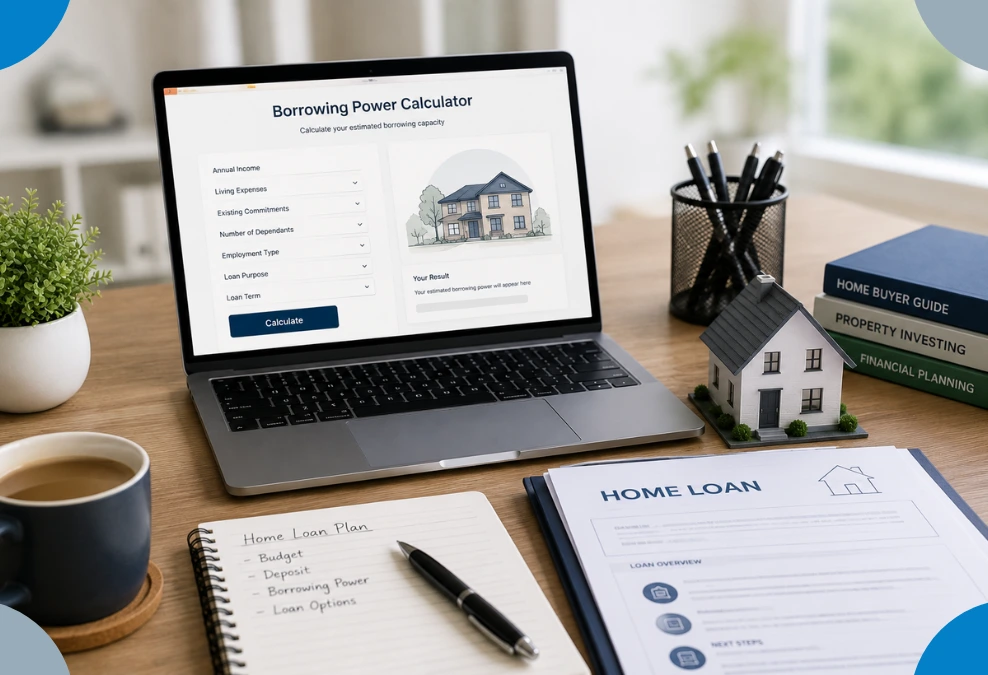
A borrowing power calculator estimates your borrowing capacity using basic financial information.
Typically, you’ll enter:
- Annual income
- Employment type
- Existing home loans
- Credit card limits
- Personal loans
- Car loans
- Number of dependants
- Living expenses
- Loan term
- Interest rate assumptions
The calculator then estimates how much you may be able to borrow.
Although useful for planning, calculators cannot account for every lender’s credit policy. Banks also assess supporting documents, spending habits and financial commitments before making a lending decision.
Think of a borrowing power calculator as a starting point rather than a guaranteed approval amount.
How Australian Banks Assess Borrowing Power
Every lender has its own credit policy, but most banks assess similar financial factors during the loan assessment process.
- Your Income
Income is the starting point for every mortgage application.
Lenders typically assess:
- Salary and wages
- Overtime (where consistent)
- Bonuses
- Commission income
- Self-employed business income
- Rental income
- Investment income
- Government payments (where applicable)
Stable, consistent income generally improves borrowing capacity.
For self-employed borrowers, lenders often require two years of financial statements or tax returns to verify income.
-
Employment Stability
Banks prefer applicants with secure employment.
Generally viewed favourably are:
- Permanent full-time employees
- Long-term part-time employees
- Professionals with stable careers
Casual employees and contractors may still qualify but usually need to demonstrate consistent employment over an extended period.
Frequent job changes can affect a lender’s assessment.
-
Living Expenses
Australian lenders now conduct detailed reviews of household spending.
Typical expenses assessed include:
- Groceries
- Utilities
- Insurance
- Childcare
- Education costs
- Entertainment
- Transport
- Medical expenses
- Subscriptions
Banks compare your declared expenses with benchmark household expenditure measures and your recent bank statements.
If your spending appears unusually low, lenders may adjust it upward during the assessment.
-
Existing Debts
Every debt reduces your available borrowing capacity.
This includes:
- Personal loans
- Car finance
- Credit cards
- Buy Now Pay Later accounts
- Investment loans
- HECS/HELP repayments
- Existing mortgages
Even unused credit card limits can reduce borrowing power because lenders assume you could access those funds at any time.
Reducing or closing unnecessary credit facilities before applying can improve your borrowing capacity.
-
Number of Dependants
The more people relying on your income, the more living expenses a lender assumes you’ll have.
Applicants with children generally have lower borrowing capacity than applicants with the same income but no dependants.
Understanding Serviceability
Serviceability is one of the most important parts of a loan assessment.
Rather than asking, “Can you afford repayments today?” banks ask:
“Could you still afford repayments if interest rates increased?”
To answer this, lenders apply a serviceability buffer by assessing your ability to repay the loan at an interest rate higher than your actual mortgage rate.
This provides additional protection for both the borrower and the lender if market interest rates rise in the future.
As a result, your approved borrowing amount may be lower than expected even if current repayments appear affordable.
Other Factors That Influence Mortgage Borrowing
Credit History
Your credit report provides lenders with information about:
- Previous loan applications
- Repayment history
- Credit defaults
- Court judgments
- Bankruptcies
A strong credit history demonstrates responsible financial behaviour and may improve your loan application.
Deposit Size
The larger your deposit, the lower your Loan-to-Value Ratio (LVR).
Benefits include:
- Reduced lender risk
- Lower repayments
- Less interest paid
- Greater likelihood of loan approval
- Potentially avoiding Lenders Mortgage Insurance
Saving a larger deposit can increase both your borrowing options and your negotiating power with lenders.
Loan Term
Most Australian home loans have terms of 25 to 30 years.
A longer loan term generally reduces monthly repayments, improving serviceability and potentially increasing borrowing power.
However, longer terms also result in higher total interest over the life of the loan.
Example 1 – Single Buyer
| Criteria | Details |
|---|---|
| Annual Income | $100,000 |
| Deposit | $80,000 |
| Credit Card Limit | $10,000 |
| Car Loan | None |
| Dependants | None |
| Living Expenses | Moderate |
| Assessment | This borrower demonstrates strong serviceability and may qualify for a higher borrowing limit compared with someone on the same income carrying significant debt. |
Example 2 – Couple Purchasing Together
| Criteria | Details |
|---|---|
| Combined Income | $180,000 |
| Deposit | $120,000 |
| Credit Card Limits | $25,000 (Combined) |
| Personal Loan | $20,000 |
| Dependants | Two Children |
| Assessment | Although household income is higher, additional debt and dependants reduce borrowing capacity during the lender’s assessment. |
Example 3 – Self-Employed Applicant
| Criteria | Details |
|---|---|
| Business Income | Variable |
| Financial Statements | Two Years Required |
| Business Expenses | Considered during assessment |
| Investment Property | Yes |
| Assessment | Self-employed borrowers often require additional documentation and income verification before receiving formal loan approval. |
How to Improve Your Borrowing Power
Improving your financial position before applying can increase your chances of approval and potentially allow you to borrow more
Reduce Credit Card Limits
Many borrowers don’t realise that lenders assess the credit limit not just the balance.
Closing unused cards or lowering limits can improve borrowing capacity.
Pay Off Personal Loans
Reducing existing debt improves serviceability calculations.
Where possible, repay smaller loans before submitting your mortgage application.
Increase Your Deposit
A larger deposit reduces the amount borrowed and lowers your Loan-to-Value Ratio.
This can strengthen your application while reducing overall borrowing costs.
Minimise Unnecessary Spending
Banks examine recent bank statements.
Reducing discretionary spending demonstrates responsible financial management and may improve your assessment.
Avoid Applying for Multiple Loans
Each credit application appears on your credit report.
Submitting several applications within a short period may raise concerns for lenders.
Maintain Stable Employment
Remaining with the same employer while preparing your application can strengthen your loan profile.
Common Borrowing Power Mistakes
Many first home buyers unintentionally reduce their borrowing capacity by making avoidable mistakes.
Common examples include:
- Applying for finance before paying off debts
- Keeping large unused credit card limits
- Underestimating living expenses
- Making major purchases before settlement
- Changing jobs immediately before applying
- Missing repayments on existing loans
- Assuming an online borrowing power calculator guarantees approval
Working with a mortgage broker or comparing multiple lenders can help identify opportunities to improve your application before formal assessment.
Avoid Applying for Multiple Loans
Each credit application appears on your credit report.
Submitting several applications within a short period may raise concerns for lenders.
Maintain Stable Employment
Remaining with the same employer while preparing your application can strengthen your loan profile.
Common Borrowing Power Mistakes
Many first home buyers unintentionally reduce their borrowing capacity by making avoidable mistakes.
Common examples include:
- Applying for finance before paying off debts
- Keeping large unused credit card limits
- Underestimating living expenses
- Making major purchases before settlement
- Changing jobs immediately before applying
- Missing repayments on existing loans
- Assuming an online borrowing power calculator guarantees approval
Working with a mortgage broker or comparing multiple lenders can help identify opportunities to improve your application before formal assessment.
Conclusion
Understanding how Australian banks calculate borrowing power is essential before applying for a home loan. While a borrowing power calculator provides a useful starting point, lenders conduct a much more detailed loan assessment that considers your income, expenses, debts, employment stability, credit history and overall financial position.
Improving your mortgage borrowing capacity isn’t always about earning more. Reducing unnecessary debt, lowering credit card limits, saving a larger deposit and maintaining stable employment can all strengthen your application.
By understanding how lenders assess risk and preparing your finances in advance, you’ll be in a stronger position to secure a competitive home loan and confidently search for a property within your budget.
FAQ's
A borrowing power calculator provides an estimate based on the information you enter. Your actual borrowing capacity may differ because lenders assess additional factors such as your spending habits, employment history, credit report and individual lending policies.
Yes. A strong credit history can improve your application, while defaults, missed repayments or excessive credit enquiries may reduce your chances of approval.
Yes. Most lenders review recent bank statements to verify:
- Income
- Living expenses
- Existing financial commitments
- Savings history
- Responsible spending behaviour
In many cases, yes. Because lenders assess your available credit limit rather than your outstanding balance alone, reducing unused credit limits can improve serviceability calculations.
Yes. A larger deposit lowers the lender’s risk, reduces the loan amount and may improve your borrowing options.